Dubai's business scene has no shortage of firms offering ISO certification, which can be very useful to buyers, but also makes the selection process more confusing than it has to be. Understanding what actually separates a reputable certification company from one that's simply chasing volume makes a real difference to the value you get out of the process.Accreditation Is the First Thing to Check
The accreditation status of a certification organization's status matters enormously, since a certificate issued by a body that isn't itself properly accredited is less valuable with clients, auditors, and tender evaluaters. The process of determining whether a certification firm holds accreditation from a recognised accreditation agency, rather than simply claiming they can issue international recognised' certificates, is the primary early indicator.
Find out the difference between Consultants and Certification Bodies
Many companies mix ISO consultants, or those who help establish a management system, with certification bodies, who independently assess and issue the certificates for the certification. The two are supposed to have distinct roles, in order to maintain an audit's independence, and a company offering both services under the same service to the same client could be a legitimate conflict of the interests to inquire about directly.
Industry experience really does matter.
A certification company with genuine knowledge of your particular industry will ask sharper, more relevant questions during the audit process. It will not apply a generic checklist process for a company with unique operational requirements. Healthcare, construction and food production all have distinct risks Auditors who are not familiar with those particulars is likely to offer a less effective audit experience overall.
See beyond the Headline Price
Certification pricing in Dubai can vary widely, and even the cheapest option may not be the best choice, however it's important to know exactly what's covered before signing. Some quotations only cover the initial audit. These quotes do not include the mandatory ongoing surveillance audits required to maintain certification which can turn an apparently low-cost deal into a much expensive multi-year commitment than a rival's pricing that is more transparent.
Consider Turnaround Time Realistically
Businesses under time pressure and often due to the approaching deadline, are often lured in by the promise of fast certification. An effective audit takes a certain minimum period of time, no matter how eager everyone involved is and extremely fast turnaround time claims should be treated with caution instead of relief.
Review Reviews from businesses operating in Similar Sectors
The direct feedback of other Dubai-based businesses operating in a similar business can provide a superior information than generic reviews, since it can reveal the way in which a certifier is in the less glamorous parts of the process, including scheduling, documentation assistance, and addressing non-conformities identified when auditing.
Make sure you consider Ongoing Support, Not Just the Certificate that you received initially.
The certification process isn't one-time as maintaining it will require periodic surveillance audits and eventual renewal. A business that provides unambiguous, systematic support throughout the year can help make that ongoing collaboration much easier than a company that is purely focused on winning the first engagement.
Ask How They Handle Multi-Site or Multi-Emirate Operations
companies that operate from multiple locations within Dubai or across a variety of Emirates, need to inquire about which certification organization handles multi-site audits as the methods differ significantly among different providers. Some companies provide an integrated auditing program for all sites under a coordinated schedule, while others treat each location like a separate project that can have a significant impact on the cost as well as the overall coherence of the certification.
Find out the distinction between UKAS, DAC, and Other Accreditation Marks
Certification organizations operating in Dubai can be accredited by several different national accreditation bodies, such as UKAS as a member of the UK or the UAE's individual Emirates International Accreditation Centre, and knowing which accreditation holds the greatest weight with respect to your specific clients and tender requirements is more important than the assumption that everything accreditations marks accepted internationally.
Make sure everything is written down before You Sign
Confidential statements about scope cost, and timeframes have a lower value than a clear written proposal covering everything that is included, what happens if nonconformities are found, as well as what the cost total will be for the whole three-year certification period instead of just the initial audit. A trusted company will be no hesitation in supplying the same level of detail before giving a formal commitment.
Make sure you trust your impressions from Initial Conversations
Beyond the verification of credentials and prices and pricing, how a certification company handles your initial queries usually reveals a lot about how they'll behave once you've signed the contract. A business that is able to answer questions in a clear manner, doesn't push the customer into making a hurry decision, or appears looking to understand your business instead of just concluding a sale is generally a safer long-term partner rather than one focused on quick signing.
Monitoring for High-Pressure Sale Tactics
Certain certification organizations operating in Dubai's highly competitive market rely on strategies for sales that are highly pressured, including an artificial urgency surrounding limited-time pricing or claims they are in the process of negotiating with a competitor to secure a particular slot. Certification bodies with genuine credentials are not required to rely on this kind of pressure, since their value proposition relies on the credibility of their accreditation and track record, rather than an aggressive sales pitch. This makes a pushy urgency an adequate warning sign.
The best choice for a certification provider in Dubai relies on verifying credentials properly, understanding exactly the cost you're paying, and prioritizing genuine experience over the cheapest headline price, since the certificate itself is only as good because of the process behind the certificate. The businesses that get the most value from certifications in Dubai will not be those who rely on the most competitive price alone. They are those that did their research to investigate accreditation, fully comprehend the entire scope of what they're buying, and select a partner that is appropriate to their particular industry and size. The checks do not take much time independently, but taken together, they create a well-informed view that can guard against the 2 most common outcomes that result from a poor choice: an not-usable certificate or an expensive ongoing contract. A little extra effort upfront is always worthwhile over the entire period of certification that comes after. View the best ISO 20000 Certification for more tips.

ISO 9001 Explained: Quality Management for UAE Companies
ISO 9001 remains the most widely recognised management system standard across the world, and it's not without reason: it's based on a practical concept, that is that quality results from consistently properly-managed processes, not just good intentions on their own. For UAE businesses considering certification, knowing what the standard will help you understand the procedure, which is often more complex than it is.What ISO 9001 Is Actually built around
In essence, ISO 9001 asks a business to identify its primary processes, understand how they interact and monitor whether they're performing, and adjust them by systematically improving them in time. Rather than prescribing exactly how the business should be run the framework provides to ensure that any strategy taken by a business has been documented where appropriate, and fully followed.
Why UAE Businesses Are Interested in It?
Beyond the value of reputational ISO certification, many UAE businesses pursue ISO 9001 because government and tenders for private sector companies increasingly include it as an eligibility requirement for prequalification. Beyond ticking that box and implementing it in a proper manner often experience real operational benefits, like fewer frequent mistakes, more transparent accountability and a more organized approach to handling customer complaints.
The Role of Top Management
One aspect the standard is very clear about is genuine leadership involvement, rather than quality management being delegated entirely to an individual compliance officer, who is isolated from the actual decision-making. Auditors are specifically looking for proof that the leadership team is aware and actively promotes the quality management system rather than simply signing off on it.
Risk-based thinking is the core of the Modern Standard
The latest Version of ISO 9001 places considerable emphasis on identifying the risks and opportunities relevant to a business's specific context, and not relying on a generic checklist regardless of the circumstances. This means a UAE construction company and an UAE software company, although both certified against the same standard can end up having very different quality systems with their own distinct risk profiles.
Customer Focus is a constant throughout the Standard
ISO 9001 repeatedly returns to the notion that quality means meeting customer demands for satisfaction, and not merely internal efficiency indicators. Organizations that adhere to the standard are supposed to implement real mechanisms for determining what customers need and measuring whether they're happy, rather than believing that internal quality control alone is able to capture the whole picture.
Its Certification Process Itself
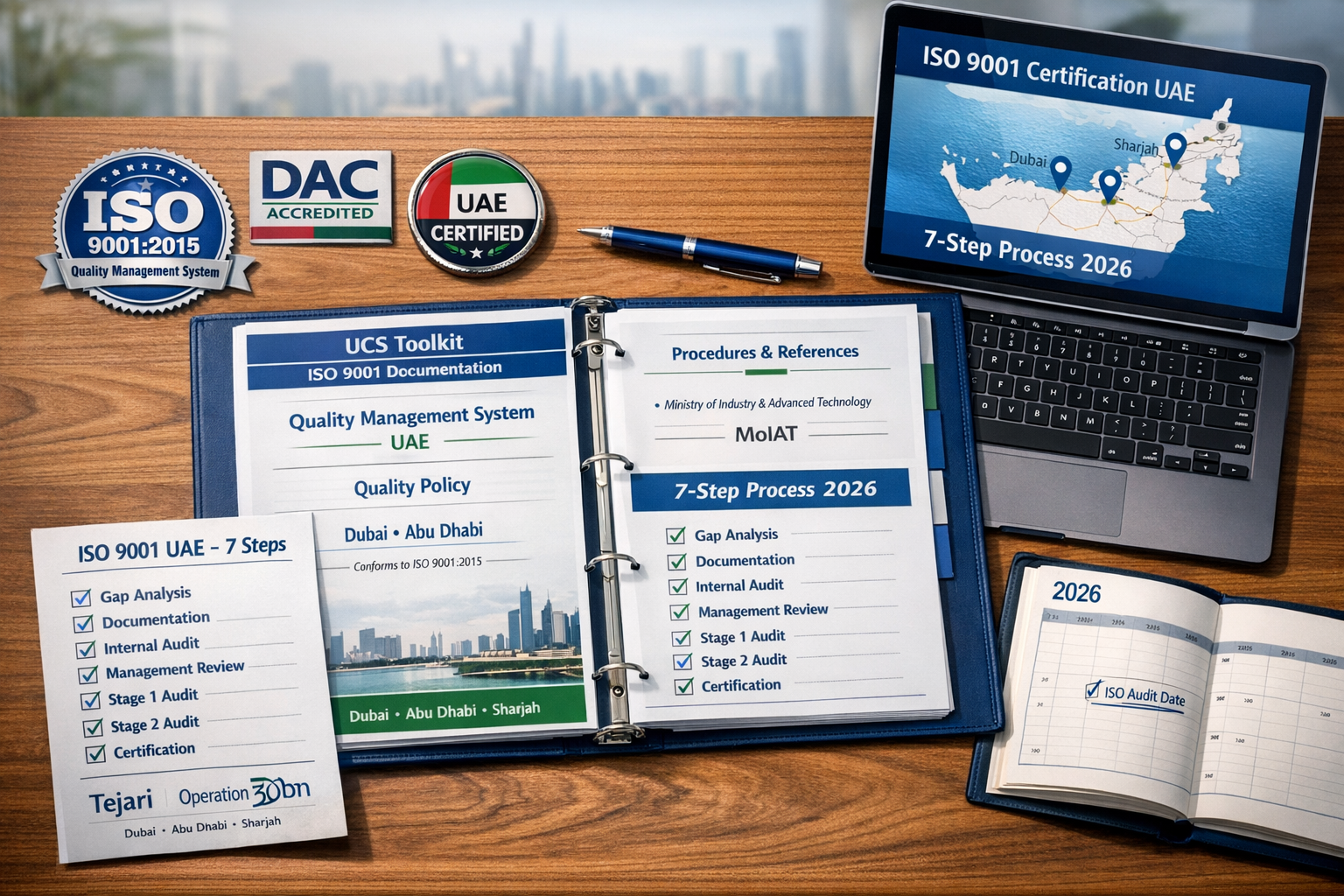
After implementing the necessary processes and documentation, the certification process involves an external inspection that occurs in two stages. The first step is to review documentation and readiness, before looking at whether the system actually operating as it is described. It is followed with annual checks of surveillance, as well as a annual recertification audit about every three years to ensure that the system is in constant conformance.
Common Misconceptions That Need To Be Dispelled
The most common misconception is that ISO 9001 requires enormous volumes of paperwork. However, the current version actually reduced mandatory documentation by a significant amount compared to previous versions, focusing instead in demonstrating true process control. Another misperception is that certification guarantees authenticity of the product. But in reality, it validates that your company has a coherent system for managing quality, and is a fundamentally different but still valuable thing.
What is the different way to apply it across Industries
Construction companies that have adopted ISO 9001 will focus heavily upon the processes of handover to projects and subcontractor administration, whereas a professional services firm might be focusing more on processes for engaging clients along with knowledge management. The flexibility of the standard across different sectors is its significance across a range of UAE industries including manufacturing, consulting and retail.
The importance of continual improvement
ISO 9001 doesn't treat quality as a single goal instead, it's a continuous process of monitoring the quality of performance, identifying opportunities to improve, then implementing those changes continuously. Companies that truly embrace the concept of continuous improvement instead of focusing on certification as an event that is only once in a while, are likely to reap an array of long-term and meaningful operations benefits from the standard.
Training Your Team to handle the Cultural Shift
Perhaps the most overlooked aspect of ISO 9001 implementation is the true cultural shift required transitioning away from informal, dependent ways of working toward more consistent, structured procedures that do not rely on one person's memory or judgement. Prepare employees for this shift, and explaining the practical advantages instead of making it solely as a compliance exercise, considerably improves how smoothly implementation is carried out.
What is the reason why an investment will pay off
Companies that adopt ISO 9001 thoughtfully, rather than simply a paperwork exercise to satisfy some external requirement, will generally find the investment pays off through less frequent errors, more transparent internal accountability, and the foundation is stronger for expanding operations as the enterprise grows. Benefits are far beyond the certification it self.
Where and How ISO 9001 Interacts With Customer Specific Complaints
The standards require businesses to have a logical, systematic process for handling customer complaints and feedback, considering each complainant as a point of data that needs to be incorporated into improved processes instead of being ignored or resolved. UAE companies that are able to create this feedback loop in the right way often find it becomes one of its most useful aspects of the management process even beyond its main function for assisting with the audit.
For UAE businesses evaluating whether ISO 9001 is worth pursuing, the honest answer usually boils down to whether they really want more efficient, consistent processes. since the certification is basically a formal endorsement of the underlying operating system. For UAE businesses who are determined to improving their operational practices instead of just collecting one of the certificates, ISO 9001 offers a well-established, internationally accepted system to ensure that the improvement is permanent rather than just a random. None of this requires abandoning what already works well within a business. ISO 9001 is fundamentally about the formalization and reinforcement of good practices rather than replacing it wholesale with a completely different system. When approached this way, certification is an inevitable extension of good management and not an external burden on the company. It is, at the end of the day an established framework based on basic principles that are consistently followed rather than anything mysterious. That more than anything else, is the main reason why it merits taking seriously. Few other investments offer such large, long-lasting value. Absolutely worth the time it takes to make the right choice. Follow the most popular ISO 14001 Certification for blog tips.